
A fictional account
A Dame's a Lousy Bet
How a third-floor walk-up on a wet stretch of Flatbush became a scouting bureau — what the first Sunday cost, and the girl who still walks the fence.
Bang the Button for a Little Atmosphere
Five tracks. Shuffle. Stops when the stack's done.
Playing the Music Frankie Likes
Rainy Mood
Mona Sax
Prologue: The Dame
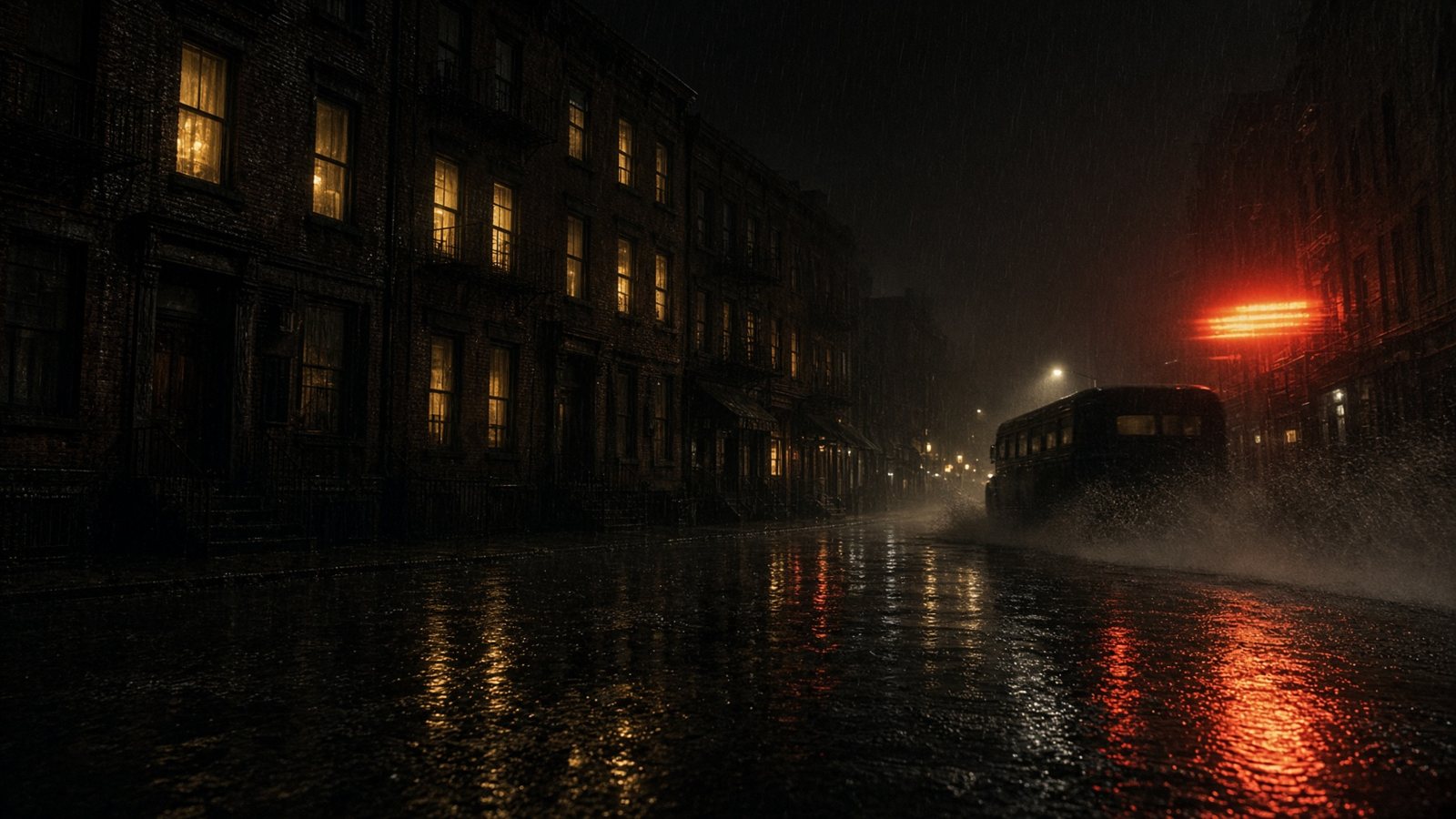
The rain had been working Flatbush Avenue over since noon, the kind of rain that doesn’t fall so much as it splatters. It needled the windows of my third-floor walk-up, turned the pawn-shop neon across the street into a smeared wound, and made the whole borough smell like wet wool and last week’s regrets. Inside, the radiator clanked like a man dying of something rancid. The blinds were yellow with a decade of other people’s cigarettes. The desk was a scarred oak slab that had seen more empty bottles than paying clients. In the top drawer sat a .38 that hadn’t been fired in anger since a bartender on Atlantic Avenue decided my tab was a philosophical disagreement. In the bottom drawer sat the rent notice, folded twice so I wouldn’t have to look it in the eye.
The frosted glass on the door still said FRANKIE FROM FLATBUSH — PRIVATE INVESTIGATIONS in peeling black letters. Underneath, in smaller type that time and a leaky ceiling had nearly erased: DISCREET. THOROUGH. REASONABLE RATES. Reasonable rates. That was the funniest joke in Brooklyn, and I was the only one still laughing.
I poured two fingers of rye that had never seen better days and watched the rain write its memoirs on the glass. The city out there was all wet brick and honking horns and men who thought a Sunday ticket stub was a retirement plan. I had been one of those men, once. Then the cases dried up, the wives stopped hiring, and the husbands started paying in promises. A private eye without a case is just a man with a license and a drinking problem. I was both.
The door opened without a knock.
She came in like the weather had sent her as an apology.
The first thing was the hair: dark brown curls pinned like a 1940s studio still, the kind of wave that looks expensive even in a cheap doorway. Then the coat, a little too thin for September rain, belted tight at a waist that made the belt look like it was doing God’s work. Then the legs. Long, pale, moving with the unhurried certainty of a woman who had never once in her life been told to hurry. Stockings with a seam that climbed like a dare. Heels that clicked on the linoleum the way a hammer clicks on a coffin nail — soft, final, interested in your attention.
She stopped in front of the desk and looked at me the way a cat looks at a saucer it hasn’t decided to drink from yet. Perfume arrived half a second later: something expensive that had learned how to slum. Gardenias and trouble. Her mouth was red enough to stop traffic on Ocean Parkway. Her eyes were the pale, dangerous blue of a gas flame on a stove you forgot to turn off.
“You’re Frankie,” she said. Not a question. Voice like warm bourbon poured over crushed ice. “The one on the glass.”
I set the drinking glass down without drinking. “That’s what it says. Some days I believe it.”
She unbelted the coat. Underneath was a dress the color of midnight if midnight had a budget. It clung where clinging was a public service and cut where cutting was a felony. The neckline did not ask permission. I made myself look at her face and failed on the first try.
“I need help,” she said. “The worst kind.”
“Most people who find this office do.”
“Not that kind.” She sat without being invited, crossing those legs with a sound like silk making a promise. A little gold compact came out of her purse. She checked her lipstick the way a gunfighter checks the load. Satisfied, she snapped it shut. “My husband bets football. NFL. Spreads, totals, the whole dirty cathedral. Bets it BIG. He’s been wrong since Labor Day. Wrong the way a man is wrong when he thinks hope is a system.”
“I don’t pick point spreads.”Frankie, before the bureau had a name
I leaned back. The chair complained. “Lady, this is a detective agency. Missing persons. Cheating spouses. The occasional embezzler with a weak alibi and a weaker chin. I don’t pick point spreads.”
“You look at people,” she said. “You look at what they hide. You look at film, if there’s film. You talk to the ones who don’t want to talk. That’s scouting. That’s what I need. Someone who can tell me if a quarterback’s arm is still there after the hit he took in Week Two. Someone who can find out if the left tackle’s knee is made of glass and smoke. My husband put fifteen thousand into the Jets last Sunday because a man in a bar told him the line was soft. The line was not soft. The line was a straight razor. We’re in a hole now, Mr. Frankie. A gaping hole, with interest.”
She said husband the way some women say alibi.
I lit a cigarette I didn’t want. Smoke drifted between us like a cheap curtain. “What’s your name?”
“Tiffany Kelly.” She said it like it had been practiced in a mirror. Maybe it had. “And before you ask — yes, that’s the name on the marriage license. For now.”
“And the husband? He know you’re here?”
A small smile. Not happy. Just accurate. “He knows I went out for air. He doesn’t know the air had an address.”
I looked at the rain. I looked at the rent notice. I looked at her, which was a mistake I intended to keep making. The dress had a way of making the office look poorer than it already was. A run in her stocking started just above the knee and traveled north with ambition. She didn’t bother hiding it. Women like that never do. They let the flaw work for them.
“I’m a private investigator,” I said, slower this time, the way you explain a map to a tourist who keeps insisting the river is a street. “I find people who don’t want to be found. I photograph motel rooms and bad decisions. I do not sit in a darkened room with a clicker and decide whether some kid from Alabama can read a blitz.”
“Can you?”
“Can I what?”
“Read a blitz. Read a man. Read whether he’s lying when he says his shoulder is fine.”
“I can read a lie. Football’s just lying with better lighting.”The moment the work changed
I thought about the last time I’d read a man. He’d been lying about a warehouse fire in Red Hook. The lie had cost him two teeth and me a week of sleep. “I can read a lie. Football’s just lying with better lighting.”
She uncrossed her legs and recrossed them the other way. The room temperature went up three degrees and the radiator had nothing to do with it. “Then read this. If we don’t hit three of the next five Sundays, the house on Ditmas goes. The car. The quiet little life he promised me when he still had hair and a plan. I didn’t come here for a sermon, Mr. Frankie. I came here because the glass on your door looked desperate enough to be honest.”
Desperate. She had me there.
I stood up, walked to the window, and watched a bus throw a sheet of dirty water at a man who deserved it. Flatbush stretched out wet and unimpressed. Down the block a bar sign flickered PACKERS +3 like it was a hymn. The whole avenue was a congregation of beer-swilling suckers waiting for kickoff.
“You want me to be a tout,” I said.
“I want you to be what you already are. Just pointed at a different kind of crime.”
I turned back. She hadn’t moved, except for the way her breathing made the dress do small, unforgivable things. There was a mole at the hollow of her throat. I hated that I noticed. I hated more that I wanted to keep noticing.
“This isn’t what I do. There are others out there who can help.”
“It is now.” She opened the purse again. Not a gun. A checkbook. The kind with a leather cover that had never known a bargain. “Retainer. Two weeks. You tell me who’s healthy, who’s hiding a limp, which offensive coordinator is calling plays like he’s daring the defense to notice. You use whatever dirty little methods you use on wandering husbands. Sources. Film. The kid who drives the equipment truck and drinks too much on Thursday. I don’t care how you get it. I care that it’s right.”
“And if I’m wrong?”
Those blue eyes held still. “Then we’re both in the hole. But at least I’ll have had the pleasure of watching you try.”
I should have thrown her out. I should have pointed at the lettering on the glass and recited the speech about jurisdiction and professional dignity and the sacred line between a dick and a tout. I had the speech ready. I had used it on bookies and bondsmen and a priest from Holy Cross who wanted me to find a missing chalice that turned out to be in the rectory all along.
I looked at Tiffany Kelly instead.
The rain put silver in her hair. The cheap lamp on my desk put gold on her collarbone. She sat there like the last good idea in a bad year, and I was a man who had run out of better ones.
“All right,” I said.
She didn’t smile like she’d won. She smiled like she’d expected the winning and was only checking the time.
“There’s a condition,” I added. “We don’t call it touting. We don’t sit in some back room with a chalkboard and a dream. We treat it like a case. Background. Surveillance. The quiet questions. If a quarterback’s throwing with a hitch, I want to know who hit him and whether the team doctor is a poet or a butcher. If a linebacker suddenly looks a step slow, I want the name of the nightclub and the girl who kept him there. Football’s a city, lady. Cities have alleys. I work alleys.”
“And what do we call the alley?”
I looked at the door. The peeling letters. The rain. The whole sodden length of Flatbush Avenue doing its best impression of a future.
“Flatbush Avenue Scouting Bureau. Private inquiries. Player evaluation. The truth, delivered before the bookies get dressed.”The name, spoken once, then kept
“Flatbush Avenue Scouting Bureau,” I said. It sounded ridiculous until it didn’t. “Private inquiries. Player evaluation. The truth, delivered before the bookies get dressed.”
She stood. The coat went back on, which was a crime against the municipal code. At the door she paused, one gloved hand on the knob, and looked back over her shoulder the way trouble always does when it wants you to follow it downstairs.
“If you say they’re good,” she said, the Brooklyn leaking into her voice for the first time, just a drop, just enough, “they better be good.”
I picked up the rye. I didn’t drink it. I just held it like a man holding a decision he already made.
“If WE say dey good,” I told the empty office after she’d gone, testing the words against the rain and the neon and the cheap ticking of the radiator, “dey IS good.”
The next morning I scraped the old letters off the glass myself. The new ones went up crooked because my hands weren’t as steady as they used to be and because Tiffany Kelly’s perfume was still living in the room like a tenant who wouldn’t leave. FLATBUSH AVENUE SCOUTING BUREAU. Underneath, smaller, the way a threat is smaller than a promise until it isn’t:

If WE say dey good, dey IS good.
Flatbush Avenue Scouting Bureau
I sat behind the desk and waited for Sunday.
The rain kept at it. Somewhere in New Jersey a quarterback was icing a shoulder and lying to a trainer. Somewhere in a film room a coordinator was drawing a play that would get a man killed for three yards and a cloud of dust. And somewhere on Ditmas Avenue a husband was staring at a ticket and calling it hope.
I poured the rest of the rye into the sink. It seemed like the professional thing to do.
Then I pulled the blinds, lit another cigarette, and started a folder the way I used to start a missing-person case: name, number, last known healthy Sunday. The first page was blank except for a lipstick smear I hadn’t noticed until now, a perfect red half-moon on the corner of the blotter, as if the office itself had been kissed and didn’t know whether to file a complaint.
I left it there.
Some evidence you don’t bag. Some evidence you just live with.
Outside, Flatbush hissed and steamed and went about the long business of being Brooklyn. Inside, the Flatbush Avenue Scouting Bureau was open for business. The bottle was empty. The gun was loaded. The dame had a husband and a hole and a walk that could start a war in a monastery.
I was still a private eye.
I was just hunting a different kind of lie.
I lit the last cigarette in the pack.
I waited for the film to arrive.
I waited for her to come back.
In this line of work, they always come back.
Especially the ones who walk like that.
Chapter 1: Initial Results
The rain came back a week later, colder this time, the kind that finds the hole in your shoe and signs a lease. It was past eleven. The pawn-shop neon had given up on being red and settled for being a wound that wouldn’t close. Down on the avenue a bus sighed and threw dirty water at nobody in particular. I had the lamp on, the blinds half-drawn, and seven folders open like a bad poker hand I was still trying to read.
Sunday had come and gone. The tickets were in the top drawer now, some of them still warm with being right, one of them cold as a morgue slab. I had told myself I would wait until morning to add it up. Morning is for honest people. I poured two fingers and did the math in the dark like the crook I was becoming.
The door opened without a knock. Of course it did.
Tiffany Kelly had put the daytime coat to bed.
What walked in tonight made the midnight dress look like church clothes. Black silk, wet from the street, clinging like it had taken a personal interest in my remaining morals. A fur wrap sliding off one shoulder as if even the fur had decided to confess. Rain in her hair. Rain on her collarbone. Heels that clicked a colder, later rhythm — not coffin nails this time. More like a judge’s gavel when the judge already knows the verdict and just wants to hear you say it.
Gardenias again. Trouble again. The office got smaller by a dress size.
“You’re still here,” she said. Voice like the bourbon had been left out overnight and gotten meaner. “Good. I hate climbing three flights for a man who already quit.”
“I don’t quit until the rye does.” I stood because some habits survive even a dame. “You’re wet.”
“Observant. That’s what I’m paying for.” She dropped the wrap on the chair that didn’t deserve it and came around the desk without waiting for geography. Close enough that I could see the rain still living on her eyelashes. “Week one, Mr. Frankie. I didn’t come back for small talk. I came back for a body count.”
“You want results.”
“I want to know if I hired a detective or a man with a pretty glass door and a drinking problem.” She sat on the edge of the desk this time, one stocking a darker seam against the oak. “The husband is downstairs in the car, pretending he’s waiting for a woman who went out for air. He thinks air takes an hour. Tell me we hit.”
I didn’t give her the speech. I gave her the folders. Each one named, numbered, last known healthy Sunday — the way I used to start a missing person, except these missing persons played on television and lied in press conferences.
“Geno Smith,” I said. “Jets. Your husband lost his shirt on that club once because a man in a bar told him the line was soft. This week we didn’t ask a man in a bar. We asked the tape. The arm was there. The eyes were there. The line was a rumor and he threw over it anyway. We played him. We got paid.”
She didn’t smile. She just let one red nail rest on the folder as if she were taking a pulse. “Go on.”
“Tyler Shough. Kid in New Orleans with a name like a farm tool and a release like he’d been waiting in a hallway his whole life. The league wanted him to look like a mistake. He didn’t. We took him. The ticket cashed.”
“Maye.”
“Patriots. The system liked the kid even when the box score wanted to argue. We didn’t bet the poetry. We bet the things he didn’t do wrong. That’s a kind of truth the public never buys until it’s too late. We bought it early. It paid.”
“Lamar.”
“Baltimore. Everybody’s favorite magic trick. I don’t trust magic. I trusted the film of him making grown men miss in the open field and still having enough arm left to ruin a coverage. We played him. We got paid again, which is the sort of sentence that makes a man superstitious if he has any sense.”
“Brissett.”
“Arizona. The veteran nobody writes poems about. That’s why I like him. Quiet feet. Clean answers. The kind of quarterback who looks like a substitute teacher until he takes your money. We took him. The window cashed.”
She tilted her head. Rainwater found a new path down her throat. I looked at the blotter instead, which was cowardice and also professionalism.
“Cousins,” I said. “Vegas. The tape said fade. Not because the man can’t throw. Because the man was throwing in a building that wanted him to fail in public. We faded him. The fade paid. That’s six.”
She counted on her fingers without looking at them. “You said seven folders.”
I slid the last one across. The name on the tab was already a bruise. “Dak Prescott. Dallas. The film said yes. The arm was there. The eyes were there. Protection was a rumor, but rumors don’t always kill you. We played him. The ticket died anyway.”
“Oddly,” she said, and for the first time the bourbon in her voice had ice in it.
“Oddly,” I agreed. “That’s the word I used at 2 a.m. when I watched it again. A play that should have been a living thing went still on the grass. Something in that game didn’t match the alley. I don’t know if it was a lie on the injury report, a coach calling plays like he’d lost a dare, or a Sunday that simply refused to be scouted. I need another week in Dallas. Maybe two. I need the equipment kid. I need the trainer who drinks. I need to know whether Prescott is a miss or a clue.”
“Six hits and a ghost. That’s not a system yet. That’s a lucky drunk with a good week.”Tiffany Kelly, collecting
I poured her a finger she didn’t drink. I poured me one I shouldn’t have. The radiator clanked, faithful as a bad conscience.
“Six hits and a ghost,” she said. “That’s not a system yet. That’s a lucky drunk with a good week. My husband can get lucky drunk for free.”
“A system is what you call it after the second Sunday doesn’t kill you.” I sat. The chair still complained. “Week one proves the method can bite. Week one does not prove the method can live. I treated it like a case and the case paid, except for the one folder that looked clean and came back dirty. That’s how the good cases start. That’s also how the ones that get you killed start. I can’t tell the difference yet.”
She watched me over the untouched rye. The silk had started to dry in places, which was a different kind of problem. “So you want what.”
“Time. And money. Another two weeks on the retainer. I keep the alley work. I keep the film. I keep the Thursday drunks who drive the trucks. I find out if Dak is an exception or a hole in the floor. If the hits repeat, we don’t have a tout’s dream. We have a machine. If they don’t, you get to fire me in that dress, which I suppose is a kind of severance.”
“And if I say no?”
“Then I scrape the new letters off the glass and go back to photographing motel rooms. And you go back to a husband who thinks a barstool is a scouting department.”
She opened the purse. Not a gun. The same leather checkbook, heavier this time, as if it had been eating. She wrote without looking at me, the way women write when the amount is a message and the signature is a dare. The pen sounded expensive. The rain on the window sounded like applause from a very small, very wet audience.
“Two weeks,” she said. “You don’t get lucky twice and call it a living. You find out how good this thing is, or you find out it was a dame and a rainstorm and a man who needed rent. Either way, I want it in writing on Sunday.”
“I don’t want luck,” I said. “I want a system that survives a Sunday when the film lies.”
She stood. The wrap went back on, which was a mercy and a theft. At the door she paused, same as before, because trouble is a creature of habit. The Brooklyn leaked in again, just a drop.
“If WE say dey good,” she said, tasting my words like they might stain, “they better keep being good.”
“Dey IS good,” I said. “Except when they aren’t. That’s the part I’m still in business to catch.”
She almost smiled. Not happy. Accurate. Then she was gone, heels on the stairs, perfume remaining like a tenant who had decided to redecorate.
I sat with the Dak folder until the lamp started to look like a confession. On the blotter, next to last week’s lipstick, there was a new half-moon, redder, later, as if the office had been kissed twice and still didn’t know how to file it.
I left both of them there.
Six folders in the paid pile. One in the open air. Downstairs a husband waited in a car and called it air. Across the river a quarterback in Dallas was icing something and telling a trainer a sentence I had not yet learned how to hear.
I put the new check in the bottom drawer, on top of the old rent notice, and felt like a man who had swapped one kind of hole for another.
The rain kept at it.
The bureau stayed open.
I lit a cigarette I could afford now, which is how you know you’re in trouble.
I waited for the next film to arrive.
I waited for her to come back.
In this line of work they always come back.
Especially after you’ve been right enough to be dangerous.
Chapter 2: Dangerous Dreams
The sign on the door now said FLATBUSH AVENUE SCOUTING BUREAU — PRIVATE INVESTIGATIONS & TALENT EVALUATION, and if you thought that was a strange combination for a business, you’d never met me, and you’d never seen what fourteen years of chasing cheating husbands and undersized cornerbacks does to a man’s sense of what belongs together.
The office sat above a tombstone store on the wrong end of Flatbush, close enough to Dunkin’ that you could smell the fried dough from the street. I kept two filing cabinets. One had case files — cheating spouses, insurance fraud, a runaway teenager or two that still kept me up nights. The other had scouting reports on quarterbacks that nobody paid to see. It was a side hustle without much hustle to it.
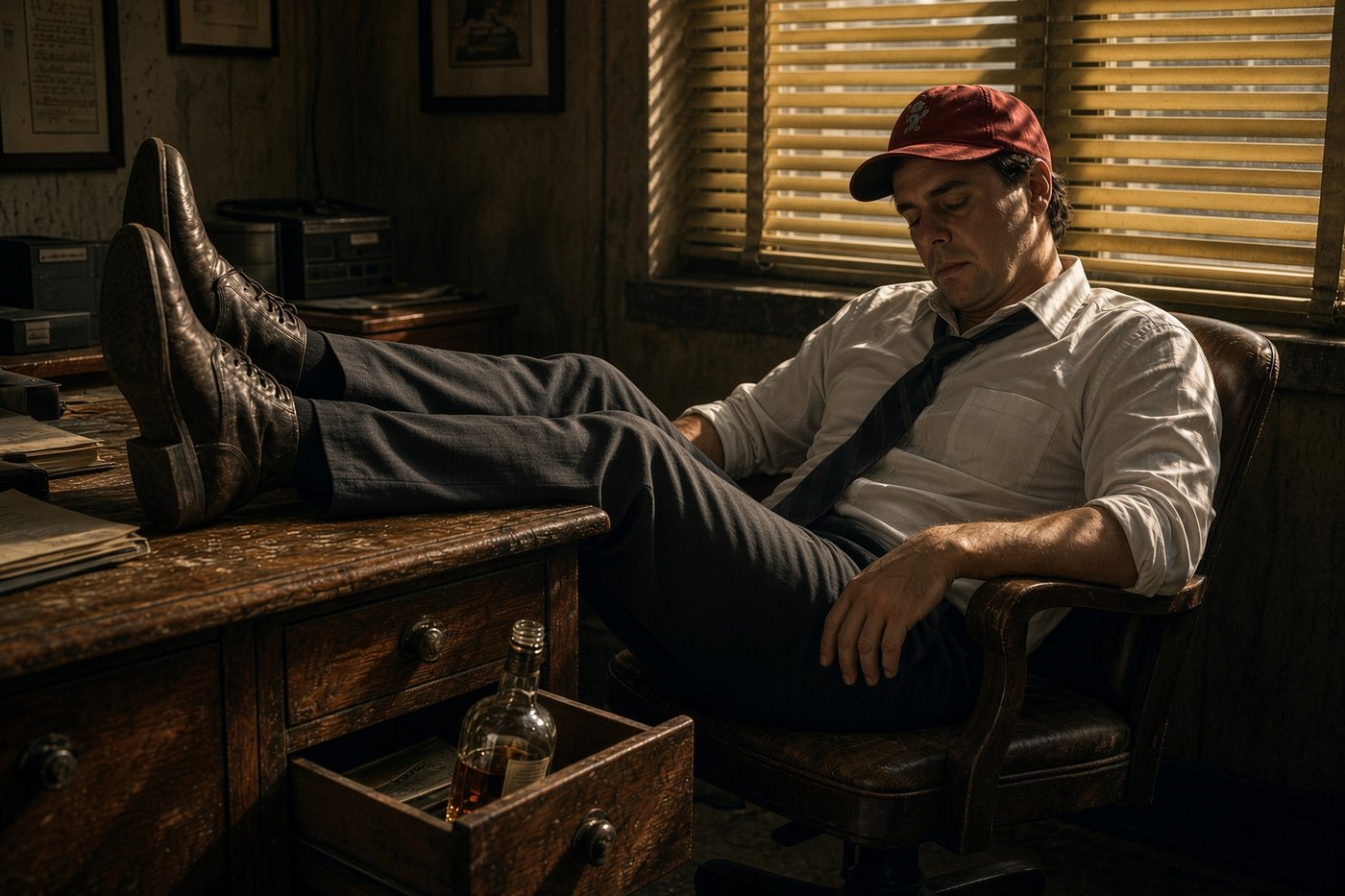
I was asleep in the chair, boots up on the desk, when the dream found me again, the way it always did on afternoons when the whiskey bottle in the bottom drawer had been visited one too many times before three o’clock.
I was twenty years old again. Not a private dick. Not a man with a bad knee and a worse liver and a Colt .38 I’d never fired outside a range. I was Frankie the freshman phenom, number 21, standing in the bullpen at a college field somewhere in the ache of an autumn afternoon, watching a girl walk along the fence line like the fence line existed for the sole purpose of being walked along by her.
Stephanie was the name she gave when she felt like giving a name. Blonde hair, a laugh that carried across a football field over the sound of forty guys in pads slamming into each other, and eyes that made every scholarship, every scouting report on me, every proud word my old man ever said, feel like small change next to the wealth of just being looked at by her.
I’d been a dual-sport man back then, the kind of athlete they profile in the local paper with a headline like Frankie Does It All. Friday nights I was the backup quarterback, the guy who came in when the starter got his bell rung, and twice that season I had come in cold and thrown a touchdown pass that made the crowd forget the starter’s name for a week. Spring afternoons I was something else — a pitcher with a curveball that dropped off the table like a man falling out of love, a fastball that touched the low nineties before the radar guns got good enough to lie about it. Scouts from three organizations had my number in their books. I was twenty years old and the whole world was a green field with a beautiful girl walking the border of it, and I thought, the way you do at twenty, that this was simply what a life was.
In the dream, like always, I was reaching for her hand, and like always, the phone rang before I got there.
My boots hit the floor. I wiped my mouth with the back of my hand and looked at the phone like it had personally wronged me, then let it ring twice more before I picked it up, because a man’s got to have some dignity even in a one-room office that smells like Marlboros and regret.
“Scouting Bureau,” I said. “If WE say dey good.”A dial tone, and the dry cleaner’s press through the floor
Nothing but a dial tone and the sound of the dry cleaner’s steam press thumping through the floorboards. Wrong number, or somebody who’d thought better of it. I set the receiver down slow and looked at the ceiling fan turning its same slow lazy circle it had been turning since Eisenhower, and let myself sit another minute in the wreckage of the dream, because some wreckage is worth sitting in.
Stephanie.
We’d lasted two years or so, which in the accounting of young love is either an eternity or the blink of an eye, and I had never quite settled on which. She was pre-law, sharp enough to argue me into the ground on things I was sure I was right about, the kind of woman who didn’t do anything by half-measures, which meant she didn’t love by half-measures either, and she didn’t leave by half-measures when the leaving came. She loved like a two-strike count — everything on the line, no margin, no easy takes. And I, who’d spent my whole life being told I had “the tools,” found out fast that all the tools in the world don’t teach you what to do when somebody looks all the way into you and decides, on a Tuesday, without much warning, that she’s seen enough.
The fights had been legendary in the way that only the fights of twenty-year-olds who think they invented heartbreak can be legendary. She’d accuse me of loving the game more than her, and there were nights I couldn’t honestly tell her she was wrong. I’d accuse her of never letting me just be good enough as I was, always pushing, always wanting the version of me she could see three years down the road instead of the one standing in front of her holding a bag of ice on my throwing shoulder. We broke up in September and got back together by Halloween more times than either of us could count, until the count itself became the relationship, until loving Stephanie McClain felt less like a feeling and more like a stat line — a batting average of the heart, and by the end of it I was hitting about .190 with the strikeouts to match.
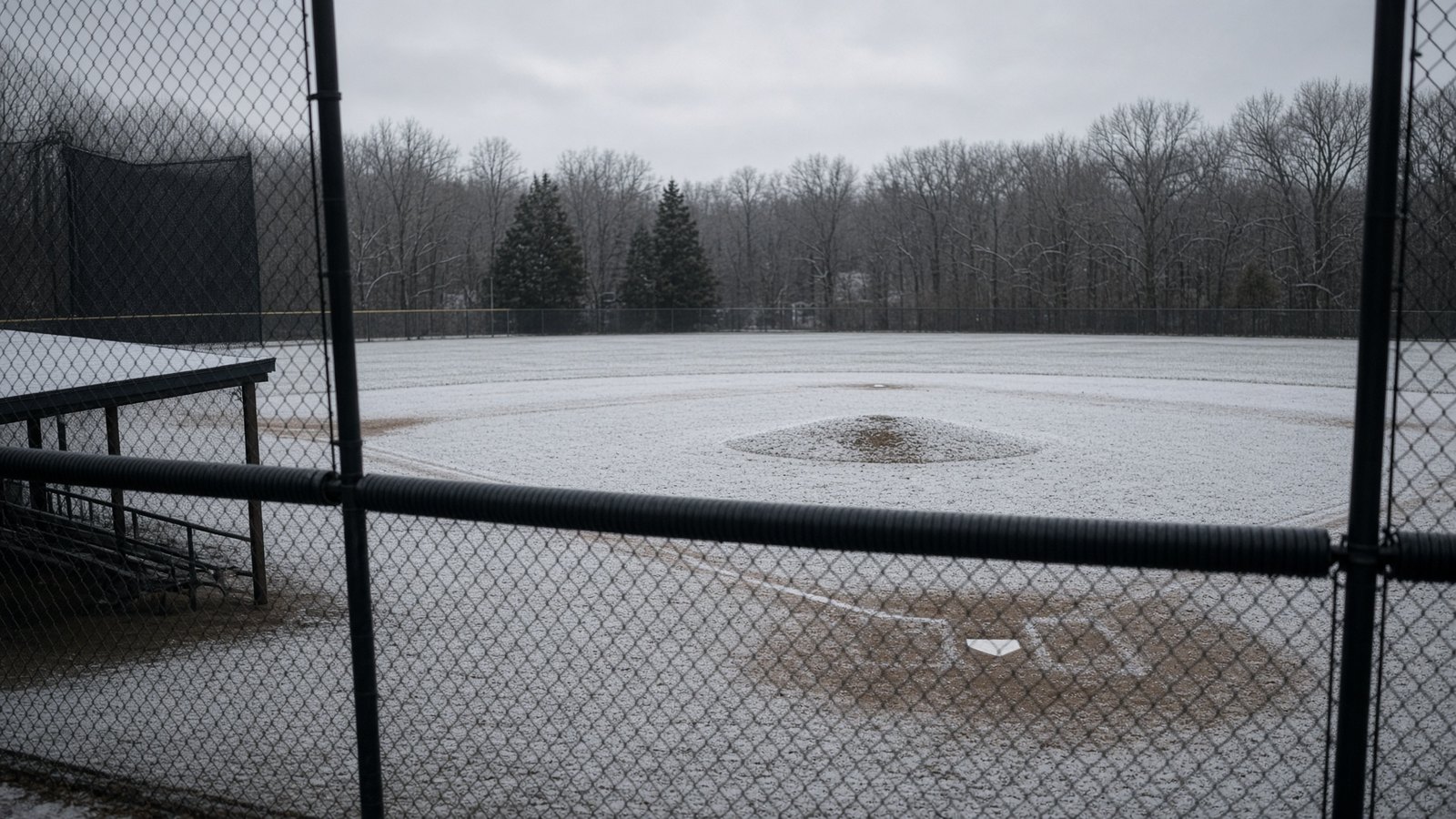
Then came the night in April, cold for the season, when she told me for the last time, and this time there was something different in her voice, something final, like a door closing that had been left cracked open on purpose for two years just so I’d know exactly how it sounded when she meant it. Snow covered the baseball field in more ways than one.
I didn’t pitch worth a damn the rest of that season. Blew out something in my shoulder that never did heal right, the kind of injury that ends careers quietly, without ceremony, the way most careers actually end, no matter what the movies tell you. The scouts stopped calling. The football coach gave the backup job to a sophomore with a weaker arm and a stronger head, and I understood, watching from the sideline, exactly what the man meant by that unspoken comparison.
I started drinking that spring the way some men start going to church — regularly, ritually, like it might save me, and by the time I figured out it wasn’t going to, I’d built a life around the ritual instead of around the salvation. The cigarettes came next, cheap ones at first, then the good ones once I had steady work, because I, if nothing else, believed a man should have standards even in his vices. I drifted through two years of nothing jobs — a stint repossessing cars, six months doing insurance investigation for a company that folded owing me back pay, a summer running security at a Coney Island arcade where I’d broken up more fights than I cared to remember, learning the particular anatomy of a Brooklyn street brawl the way I’d once learned the seams of a baseball.
It was an old scout named Gutteman who’d steered me toward the private eye work, told me over coffee at an Avenue N diner that had since become a check-cashing place, “Frankie boy, you got the eyes for it. You always knew where a man was gonna go before he went there. That’s all this job is. Same as reading a defense.” And it turned out the old man was right, in the way old men who’ve watched a hundred young men ruin themselves are so often right. I had an instinct for the tell, the flinch, the half-second hesitation before a lie — I’d read it in a thousand linebackers trying to disguise a blitz, and it turned out cheating husbands weren’t so different from linebackers, not really, not when you got down to what moved underneath the surface.
The scouting side of the business had come almost by accident, a favor for Gutteman that turned into a reputation, small as it was, for a man on Flatbush Avenue who knew talent and knew how to write it up straight, no favors, no puffery, no telling a coach what he wanted to hear about his sister’s kid. It didn’t pay much. But it kept me close to the green rectangle that had once been the whole of my future, let me stand on cold metal bleachers on Saturday mornings and watch seventeen-year-olds with their whole lives still uncomplicated in front of them, and if there was an ache in that, well, I had learned to carry aches the way other men carried a wallet — always on me, rarely looked at, present just the same.
I never did marry. There’d been women since Stephanie — a nurse from Bay Ridge who’d lasted the better part of a year, a bookkeeper who left me for a dentist with better hours and worse hands, according to her — but none of them had taught me what Stephanie taught me, which was this: that the things you’re good at and the things you love are not always the same thing, and a man who confuses the two will spend his whole life running patterns he doesn’t understand, throwing to a receiver who isn’t there. Baseball had taught me patience. Football had taught me that getting hit was part of the job and you got up anyway. But Stephanie — Stephanie had taught me that a person could see the whole of you, the good arm and the bad decisions both, and choose, in the end, to leave. That was a lesson no coach ever ran a drill for.
The phone rang again, and this time I let it breathe two rings before I answered, an old habit from Gutteman, never sound like you were waiting.
“Scouting Bureau.”Never sound like you were waiting
A woman’s voice this time, clipped, nervous, asking was this the detective, the one who found her husband’s mistress last spring, because she had a similar sort of problem and she’d heard I was discreet.
I reached for the legal pad, the same motion, more or less, that I used to reach for the rosin bag, and told her to come by the office, three o’clock, second floor above the dry cleaner, can’t miss the sign.
I hung up and looked out the window at Flatbush Avenue doing what Flatbush Avenue always did — buses, bodegas, a kid bouncing a basketball against a stoop with a form that I, out of pure reflex, clocked as decent, maybe worth a phone call to somebody someday — and I thought, not for the first time, that a man’s whole life could be read like a scouting report. Strengths: instinct, nerve, an arm that used to be something. Weaknesses: closes on the wrong things, drinks when the count gets full, can’t let go of a girl who walked a fence line eighteen years ago like she owned the whole state of grass on either side of it.
I lit a cigarette, poured two fingers into a coffee cup that hadn’t seen coffee in a decade, and waited for three o’clock, and for whatever trouble was about to walk up my stairs wearing perfume and a lie.
Chapter 3: Down Goes Geno
It was Wednesday, which meant whiskey was half-price down at Coztello’s. How could a man think about anything else after a five-win, four-loss week of rolling the bones on NFL quarterbacks? Tiffany was about to walk in, looking like all the world could be hers but for the asking, and I’d have to show her the sadness of the board, which was like a rollercoaster without much coasting.
A man can only handle so much sober.
First bet of the week: over 60.5 total points on Buffalo–Denver. Got 33% odds from the book, so the squares were deaf to the siren call of the sharps, with both defenses struggling this early in the season. Hit.
Then it was pretty obvious, if you scouted the previous game the way the Bureau had, that Cooper Rush was completely lost in that Falcons offense. Carolina over 4.5 was another easy hit.
Then the body blow that caused a blood run. A tight, hard-fought contest, in which Geno Smith — the dossier’s favorite — and the Jets took the perennial playoffsters, the greasy grimy Green Bay Packers, right down to the slick wire. A tight operation here, a special-teams tackle there, and victory was for the taking. Instead the Jets simply won against the spread. The dough cashed, but the pain lasted. Blue-label stuff even seemed toxic, not elixic. In the boroughs of Brooklyn and Queens, dogs could be heard moon-howling and midnight-prowling. Hit.
The Browns pulled a fast one, with Deshaun Watson getting off the mat and taking it to the Buccaneers. Baker Mayfield, fresh off a big-dough contract signing, seemed more like a fat cat than the backyard brawler we all know him as. Miss.
Jacksonville–Denver was a lesson in unpredictability. Bo Nix is the king of waking up in the fourth quarter. Trevor Lawrence tends to do the opposite. Probably two teams worth avoiding when you’re laying the dough on the tracks. Miss.
The former San Diego Chargers are the surprise of the league through the first two weeks. Crowned king too early, or a gelatinous mess of a team with Gomer Pyle coaching? The Raiders have played better than expected — a hat tip to a smart-playcalling head coach, and perhaps a lesson to clubs looking to hire next cycle. Kirk Cousins defies time once again and clocks Justin Herbert right in the kisser. Miss. We, in fact, did not like that.
The Cowboys and the Rams got us right again, though, on two easy calls. Hit. Hit. And we end the week five-and-four, plus seven units on the season. Ten-and-six overall. But is it enough to pay out to Tiffany and keep a profit?
She didn’t knock. The door knew her by now, and so did the lamp. Gardenia came in first, then the coat, then Tiffany Kelly in a dress that had opinions and the nerve to say them out loud. The office was dry. The street could keep its rain. In here there was only the bottle, the blotter, and a woman who had not come to hear a man congratulate himself.
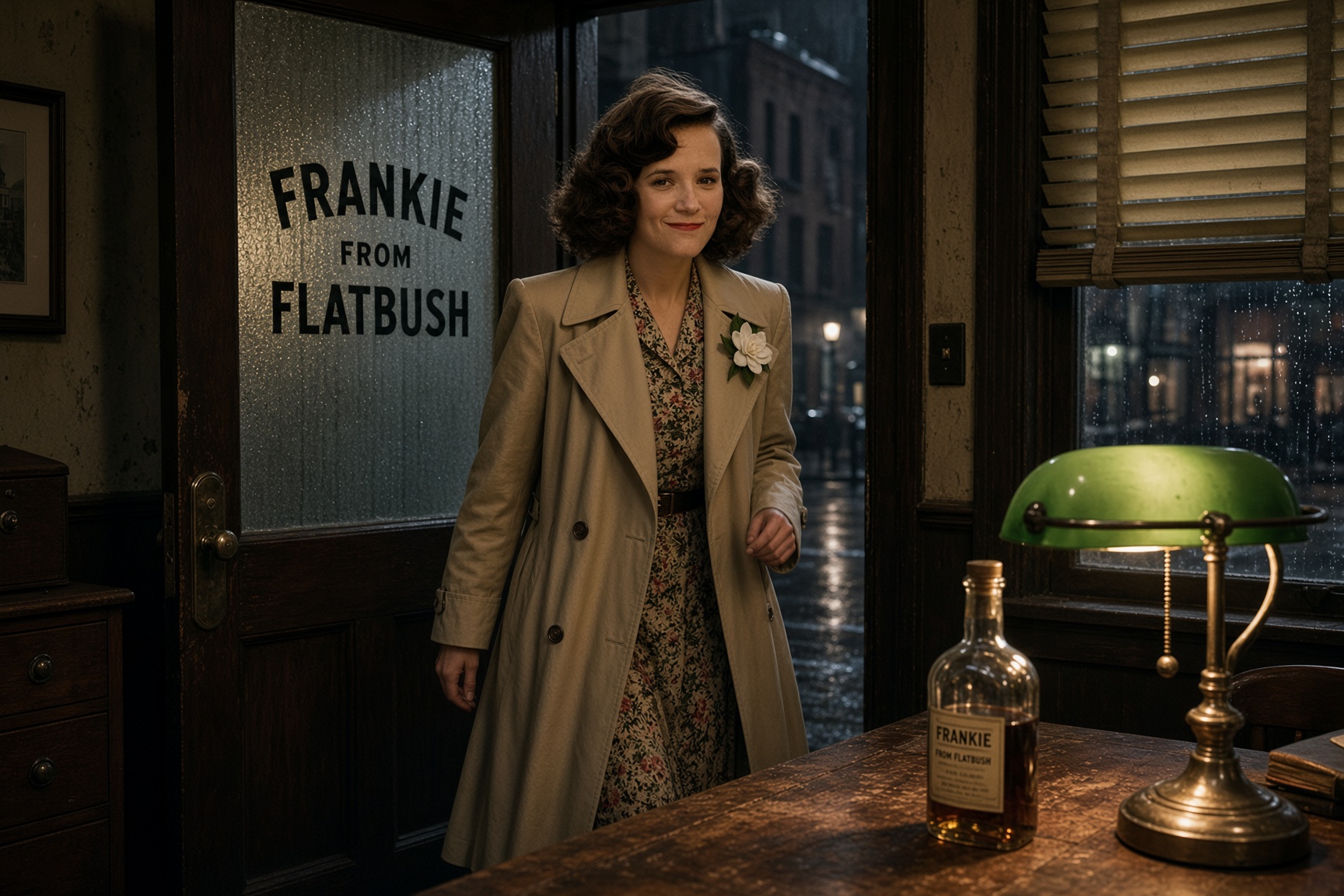
“Esmeraldo,” she said, and set her husband’s name on the desk the way you set down a glass you already know is cracked.
He was deeper in it. Deeper with the Flatbush Flyers’ book, which in this borough is not a metaphor and not a hobby. The Flyers are a known outfit — athletic when they feel like showing off, artistic when the light is kind, and pugilistic the moment a number comes due. The bookie on the account was a fellow she would only call Chris Something-or-Other, which is what you call a man when his real name has knuckles. Chris keeps the tickets. Russell, of the same club, keeps the quiet money. You can owe one of them and still walk. You do not want to owe both, and you do not want your wife walking into a third-floor office to say the second name out loud.
She looked at me the way a woman looks at a fire escape: not pretty, but it goes somewhere that isn’t the floor.
I slid next week’s card across the oak. Another Sunday. Another chance at redemption, which is a word bookies invented so debtors would come back smiling. The system was only now learning how to stand up — the tape, the ScoutScore, the EPA per drive, the Clay grades, all of it finally talking in the same room. One more week and we’d know whether I had a living or a story I told the rye.
“It’s not enough,” she said.
Then she cried, and not for the room. For Esmeraldo, for the vig, for the particular Brooklyn math in which a man can be loved and still be a number somebody else owns. I let her. I have never been any good at stopping a true thing once it starts.
“I can walk it to Russell,” I said. “Float a loan. Keep the lamp on into next Sunday. I’m not promising he’ll say yes. Russell doesn’t float favors. He floats numbers, and he likes his better than he likes me.”
She stopped the way a gambler stops counting when the card he wanted shows its face. She came around the desk. What she offered was not a contract and not quite a kiss. It was a promise made with the line of that dress and the slow, unhurried way she let the lamp understand there was more of her than it was being paid to see. An incentive. Specific. Curved. The kind of offer a professional is supposed to file under Do Not and a man with my radiator files under Try.
“Really,” she said. “Really hard.”
I told her I would.
I did not tell her I was already afraid of the answer.
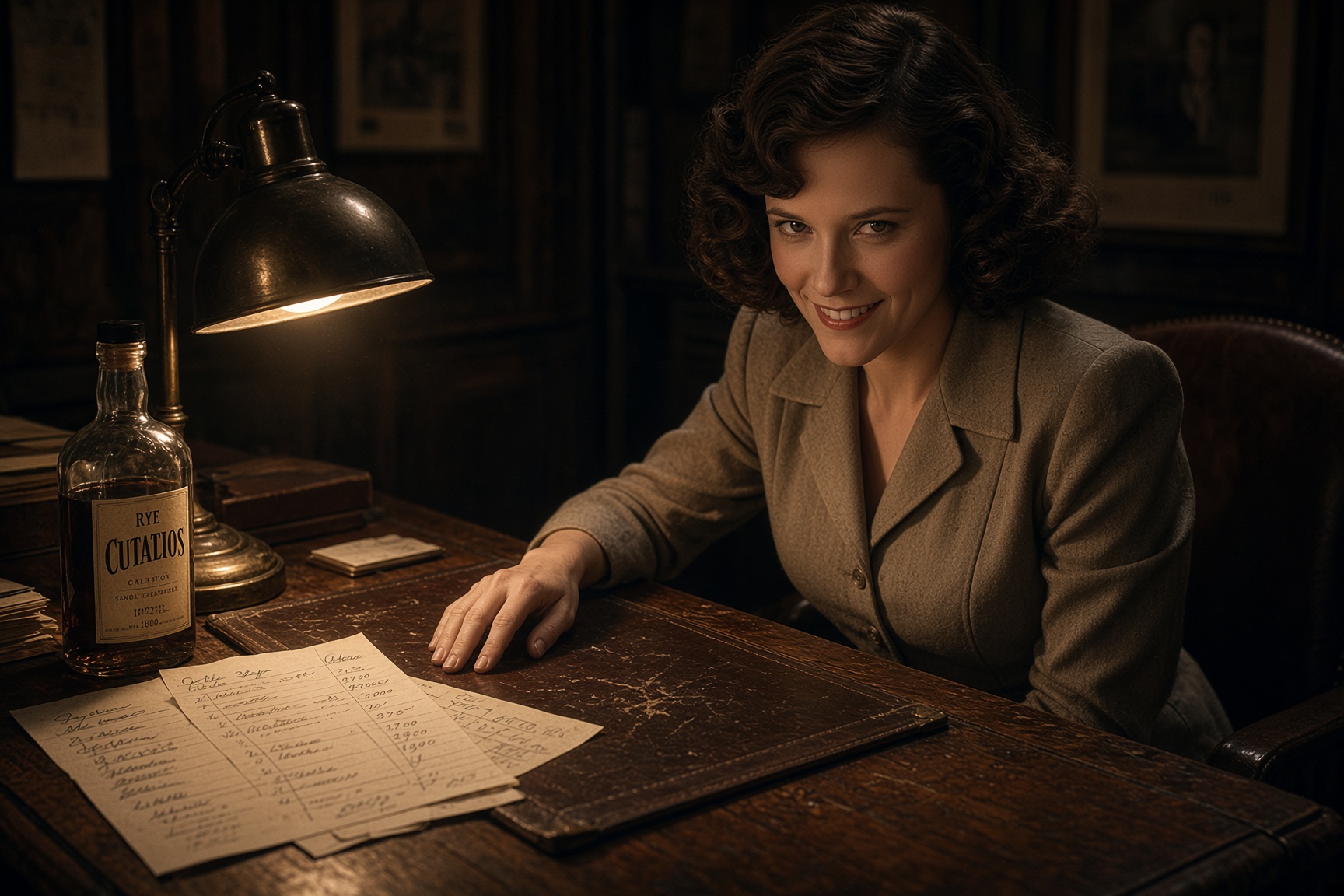
The door closed as light as the breeze, her gardenia perfume still wafting around like some kind of sexy ghost. I went back to the bottle, my mind racing along without a clear destination.

Who were the “good ol’ boys” in “American Pie” anyway?
Was Alan Wake just trapped inside a dream within a dream?
My swirling thoughts went black as the night closed in, sleep mercifully dealing the knockout blow I so desperately needed.
Chapter 4: Loan Shark
I had to get to Kimball Street. People in general, out in the hinterlands of Brooklyn and beyond, had no need to get to Kimball Street, except the people who lived there, but I did. I was on a mission to see this Russell character, of the infamous Flatbush Flyers outfit.
Rumors about the Flyers flew around the borough like winged demons on a case of Red Bull. They were like shadows if shadows were everywhere, day or night.
The rest of the houses on the street were unremarkable or dilapidated, but the one at the address Turtle the Fence gave me stood out. It was clearly built before the rest of them, and it had a strangely unique architecture any house would have a hard time matching.
It sat back from the sidewalk like it was embarrassed of the company it kept, ringed by a wrought-iron fence gone orange with rust, the gate hanging open on a hinge that hadn’t seen oil since Prohibition. Three stories of gray stone with a widow’s walk on top, which made no sense a mile and a half from the water, and windows set at angles that didn’t quite match up floor to floor, like the place had been assembled by three different architects who never spoke to each other and all of them were a little bit drunk. A weathervane up top spun slow in a wind I couldn’t feel down at street level, and it wasn’t shaped like a rooster or an arrow. It was shaped like a stickball bat, black against a sky the color of dishwater.
I’d come because I needed money, and I needed it fast, and the bank on Flatbush Avenue doesn’t hand out loans to men whose collateral is a hunch about a Sunday afternoon coin flip dressed up as professional football.
The dame who’d walked into my office three days before — Tiffany Kelly, she called herself, though I had my doubts a woman that carefully put together came out of the womb with a name that simple — had a problem. Her problem had a name too: forty thousand dollars, owed to men who did not accept excuses as a form of currency. She’d heard I had a gift. I did. I found out, recently, that I could read a point spread the way other men read a woman’s face. She needed the number to go from forty thousand to zero before a particular Tuesday, and the only road I knew that ran that direction fast enough required capital I didn’t have. So I went looking for capital. Which is how a man ends up on Kimball Street on a Thursday evening, walking up a stone path with weeds pushing through the cracks like they were trying to escape something underneath.
I knocked. The door was black, lacquered, with a brass knocker shaped like a hand holding a small brass ball, and when I lifted it I could’ve sworn the fingers were warm.
The man who opened it wasn’t Russell. He was built like a filing cabinet with a neck, wore a suit that fit him the way a tarp fits a boat, and he looked at me the way a bouncer looks at a man who might be trouble or might just be a mistake somebody else was about to make.
“Frankie,” I said. “Turtle the Fence sent me.”
He didn’t say anything. He just stepped aside, and I walked into a front hall that smelled like furniture polish and something underneath it, something old and sweet, like flowers left too long in a vase. There was a chandelier up above that had too many arms for a chandelier, and half the bulbs in it were out, and the half that weren’t flickered on a rhythm that didn’t match anything, like a heartbeat skipping every third beat on purpose. Portraits lined the hallway, men in old-fashioned collars, and I want to say their eyes didn’t follow me, and I want to say that with real conviction, but I’d be lying through my back teeth if I did say that. So I won’t.
The filing cabinet in the suit led me down a hall, past a room where I heard, very faintly, what might have been a woman laughing or might have been a hinge that needed grease, and out through a door at the back into a converted garage that stood apart from the main house, connected by a covered walkway strung with naked bulbs, as naked as the city with a million stories but only a handful worth telling. Big man lumbered back to wherever he was before. Probably a cage of some sort.
And there Russell was.
He was a tall, thin man. That was the first surprise. You hear “Flatbush Flyers” and “loan shark” and your mind builds you a two-hundred-and-forty-pound Sicilian with knuckles like walnuts, and instead you get a fellow maybe six foot four, thinning on top, reading glasses pushed up on his forehead, wearing a cardigan sweater the color of weak tea. He had his back to me, bent over a machine that took up most of one wall of the garage — a towering, homemade contraption of drums and cymbals and horns and wires, pedals sprouting off the bottom of it like roots, a guitar neck bolted in at an angle, a washboard, what looked like an honest-to-God church organ pipe jutting out the top. Wires ran everywhere, in loops and bundles, disappearing into a control panel studded with switches that Russell was flipping one at a time, listening after each flip with his head cocked like a man tuning a radio to a station only he could hear.
“You’re the football man,” he said, without turning around.
“You heard of me?” I said.
“We hear of everything going down on Flatbush. Sit down. Not on that — that’s rigged to the bass drum, you’ll set off the whole rack.” He pointed with his elbow at a stool by the workbench, and I sat down with all my might.
He kept working a minute more, adjusting something with a screwdriver no bigger than a toothpick, and then he turned around and looked at me with eyes that were sharper than the cardigan let on, gray and patient and unhurried, the eyes of a man who has spent a career deciding who gets money and who doesn’t and has never once regretted a decision either way.
“You know what I do,” he said. It wasn’t a question.
“I’ve got a fair idea.”
“I lend money to people who can’t get it anywhere legitimate, at a rate that reflects the risk, and I expect it back on a schedule that isn’t negotiable after the fact. That’s the whole business. Simple as a nickel.” He wiped his hands on a rag hanging from his belt. “You want to borrow against football bets.”
“That’s the shape of it,” I said. “Got anything to drink?”
“You don’t need no drinks. Football bets.” He said it slow, like he was turning the words over to check for a hidden edge. “You know how many degenerates I’ve had sit on that stool and tell me they’ve got a system? A lock? A guy on the inside? Every one of them owns two suits and a story. And every one of them is still paying me off six ways from Christmas, or they’re not paying me at all anymore, on account of… certain circumstances.” He let that sit there a second, the way a man lets a check clear before he spends it. “So convince me you’re not a degenerate with a new-fangled wagerin’ system.” He laughed a little, which surprised me.
“I’m not betting on hunches,” I said. “I scout it like a front office scouts it. I watch the tape. I know which offensive line’s been shuffled by injury before it hits the wire services, I know which quarterback’s been favoring a shoulder in practice, I know which coach panics in a two-score game and which one doesn’t. That’s not a system. That’s a trade. I’ve been doing it eleven months, clean, and I’m up sixty-three and a half percent against the spread over the last two weeks. You can check the number. I keep a ledger.”
“Everybody keeps a ledger.” But he was listening now, the screwdriver still in his hand, forgotten. “Sixty-three percent’s a nice number. Sixty-three percent for how much volume?”
“And a half.”
“What?”
“Sixty-three and a half.”
“And a half,” he said, a wry smile wiggling out on his face.
I told him about the volume. I wasn’t sure if I were lying or not. He whistled, low, not impressed exactly, but recalculating.
“And the money,” he said. “Where’s it actually going? Man like you doesn’t need a loan for himself. You dress like somebody who’s been eating regular.” He looked me over, cataloguing, the way you’d check a used car for rust under the paint. “So who’s the money really for?”
I hadn’t planned on telling him about Tiffany, of course, but something about the room — the low light, the smell of machine oil and old flowers, Russell’s patient gray eyes — pulled it out of me anyway, the way a good interrogator gets a confession out of an innocent man just by waiting long enough in a quiet enough room.
“A client,” I said. “She’s in a hole with people who don’t do payment plans. I can bet her out of it, but I need bankroll to move fast enough. That’s the whole play. It’s not for me. I don’t lose sleep over my own action — I lose sleep over hers.”
Russell nodded slowly, like I’d said something he could work with. “That’s either the smartest thing you’ve told me or the dumbest, and I haven’t decided which.” He set the screwdriver down on the workbench, careful, like it mattered where it landed. “Here’s my trouble with football money. Cards, I understand. Horses, I understand — a horse can’t fake a heart attack for the boys running the tote board, mostly. But a football game’s got twenty-two men on it who all answer to somebody, and a spread can move eight points on a rumor that turns out to be somebody’s cousin talking too loud in a bar. I’ve financed shooters, Frankie. I’ve financed men who owed money to men worse than me. I have never once financed a football bettor who didn’t eventually come back to this garage and tell me a story about a blocked punt.”
“Then ask me the numbers,” I said. “Ask me anything. Ask me who I like this week and why, and if I can’t back it up with something you can go check yourself, throw me out on the sidewalk and I’ll walk back to the train.”
He looked at me a long moment, and behind him the machine ticked once, some cooling wire contracting, like the whole contraption was breathing.
“What’s that thing,” I said, mostly to change the temperature of the room, but also because I genuinely wanted to know.
And something in his face opened up, the way a face does when you ask a man about the one thing he actually loves instead of the thing he does for a living.
“That,” Russell said, turning to face it like a man introducing a friend, “is a one-man band. My one-man band. Twelve years building it. Drums, cymbals, hi-hat, all pedal-operated. Guitar’s wired to trigger off a set of contact mics, so I can play it without my hands ever leaving the console if I want to loop it under something else. Organ pipe’s off a church they tore down in Canarsie — I got there before the scrapper did. Washboard’s just for color, honestly, but a song needs texture the ear doesn’t expect, or it’s just noise arranged politely.” He flipped a switch and the machine gave a soft, warm hum, like it was clearing its throat. “I play it at night. Whole house is empty at night, mostly, except for business, and this is the only thing in it that talks back to me honest.”
“You writing something now?”
He hesitated, the way a man hesitates before he shows you a photograph of somebody he loved and lost. Then he reached over and flipped three more switches, and the machine came alive — a slow, rolling harmonica line first, the drum kicking in soft under it, and then his hands went to the guitar neck and he played eight bars that were, I’ll say it plain, genuinely good. Moody, a little bit mournful, a horn line coming in off a second pedal that gave it a lift right when it needed one, like a man walking into a dark room and finding somebody left a lamp on for him.
“Working title’s F Song,” he said, a little sheepish, easing off the pedal, letting it fade. “Haven’t landed on the real name yet. Might not ever. Some things don’t want naming, they just want playing.”
I sat there on that stool in a garage full of stolen church pipes and rigged bass drums, in a house that felt like it had opinions about the people inside it, and I told him the plain truth.
“Russell, that’s awesome. I mean that. That’s not a hobby, that’s a second trade you’re good at.”
He looked at me like I’d handed him something he didn’t get handed often — not flattery, he could smell flattery from across the borough, but plain, unbothered honesty, the kind a man gives when he’s not angling for anything.
He killed the machine, wiped his hands again on the rag, and reached for a ledger of his own, sitting on the shelf above the workbench, its spine cracked from years of use.
“Sixty-three percent,” he said, half to himself, opening the book to a fresh page. “Alright, football man. Let’s talk terms.”
“And a half,” I reminded.
“And a half,” he confirmed.
Chapter 5: Freckles Don't Lie
Turtle the Fence ran his operation out of the back of a pawnshop on Nostrand, a shop that sold exactly nothing anybody wanted and moved exactly everything anybody needed, if you understood the difference, and most people didn’t, which was the whole point. I found him behind the counter polishing a trumpet that had never been played by anyone with talent, working the rag into the bell like he owed the horn an apology.
“Turtle,” I said. “Owe you a thank you.”
He didn’t look up. “Russell come through?”
“Terms are a crime against the human spirit, but yeah, he came through.”
“He always comes through. That’s what he does.” Turtle set the trumpet down and finally gave me the courtesy of his eyes, which were small and wet and missed nothing, the eyes of a man who’d spent forty years watching what people did with their hands instead of listening to what came out of their mouths. “You want to thank me, Frankie, thank me by listening to what I’m about to say, because I don’t say it for free and I don’t say it twice.”
“I’m listening.”
“Word’s moving on the girl.”
“Tiffany?”
“Word’s moving that Tiffany ain’t half of what she’s selling you. Word’s moving she’s got a crew, and the crew’s got tools, and the tools ain’t for opening bottles.” He wiped his hands on the rag like he was wiping off something that had gotten on them just from saying it. “Some fellas outta Flushing. Not local talent, which means somebody paid for import, which means somebody’s serious. She’s stringing you along till there’s enough cash in that office of yours worth the drive over the bridge, and then she’s gonna open the door for ’em, and you, my friend, are gonna be a very surprised man in a very short amount of time.”
I felt the thing in my chest that I always felt when somebody told me something true about a woman I’d already decided not to believe true things about. It sits right under the sternum, that feeling, cold as a dropped fly ball. And I realized I hadn’t given her the third degree like I normally do to a client. Women really know what they’re doing when they get dolled up.
“Turtle,” I said, “you ever see her up close? Freckles across the bridge of her nose like somebody flicked a paintbrush at her by accident. A woman doesn’t get freckles like that unless the sun’s touched her a thousand honest afternoons. And the decolletage—” I stopped myself, because there’s no dignified way to finish that sentence, and finished it anyway. “The decolletage doesn’t lie, Turtle. A dress like that isn’t a disguise. A woman like that isn’t playing an angle. Freckles don’t lie. And a body built like a Tuesday doubleheader doesn’t know how to tell a lie either. It’s not in the anatomy.”
Turtle looked at me the way you look at a horse that’s already decided which way it’s going to run before the gate opens.
“That’s what ruins a man,” he said, quiet, like it cost him something to say it. “Not the crooks. Not the cops. Not the vig. It’s his own eyes, lying to his own heart, and his heart too stupid or too lonely to check the math.” He picked the trumpet back up. “You go on believing in freckles, Frankie. I hope they’re worth what they cost ya.”
“Not the crooks. Not the cops. Not the vig. It’s his own eyes, lying to his own heart.”Turtle the Fence, who doesn’t say it twice
I left the pawnshop with that sitting on top of the other cold thing already sitting in my chest, and by the time I got back to Flatbush Avenue I had the two of them keeping each other company, like a couple of drunks holding each other up outside a closed bar.
She was in my office when I got there. That was new. Usually I got there first, sat behind the desk, let her make her entrance across the linoleum like it was a runway laid down just for her benefit. This time the door was unlocked, the lights were on, and Tiffany was sitting in my client chair with her legs crossed like a woman who’d been born knowing exactly what to do with a pair of legs.
She’d gone blonde. A wig, full and soft and the color of a wheat field in a state I’d never been to, and under it that red dress, red like the last strike of a Sunday sunset, red like something you’d get arrested for looking at too long on a subway platform. She stood when I came in, and she came at me with her arms out like a woman greeting a soldier home from somewhere far worse than a hidden pawnshop on Nostrand Avenue.
“Frankie.” She said my name like it had three syllables instead of two, like she was savoring it. “I missed you. Isn’t that silly? It’s been two days and I missed you like it was two years.” Her voice was syrupy poison.
“Two years is a long time,” I said, thinking of the fence line, thinking of a girl walking it, and shook the thought off like a dog shakes off rain. “New look for… Halloween?”
She touched the wig, laughed a laugh that started somewhere low in that red dress and climbed all the way up. “Oh, this? I’m in a play. Community theater, over on Church Avenue, nothing you’d have heard of. We had rehearsal all afternoon and I just — I never took it off. Isn’t it awful? I probably look like somebody’s kid sister trying to sneak into a nightclub.”
She did not look like anybody’s kid sister. She looked like the reason nightclubs installed doormen.
“You look fine,” I said, which was the understatement of a career built on understatement, and sat down behind the desk to put something solid and wooden between the two of us, because a man needs a defensive line sometimes, even a bad one. “Got good news. Russell came through. Five grand, at a rate that’ll put his kids through college on my dime, but we got it. We’re solid for Sunday. The slate’s bettable. We got some angles.”
Something moved behind her eyes when I said the part about paying Russell back, quick as a minnow, gone before I could get a good look at it. Maybe it was nothing. Maybe it was Turtle’s voice sitting in the back of my skull, putting shapes into shadows that were probably just shadows.
“That’s wonderful,” she said, and she meant it the way an actress means her lines, which is to say completely, in the moment, with nothing held back and nothing underneath it you could put your finger on. “I’ll come back Sunday night, after the games. We’ll celebrate properly.” She let that last word do some heavy lifting, the way she let most words do heavy lifting. “But I wanted to give you something first. For luck.”
“I don’t need luck. I need the Lions to fall apart.”
“Everybody needs luck, Frankie. Especially men who think they don’t.” She reached into that dress — and I want it on the record that I am a professional, that I have a P.I. license and a scouting reputation to protect, and that I looked away exactly as long as decency required, which in my case is a shorter interval than in most men’s — and came out with a small, worn card, soft at the corners the way old cardboard gets soft, like a thing that’s spent forty years in someone’s wallet being touched for comfort.
“My sister gave me this,” she said, and for just a second the actress dropped out of her voice and something else came up through the floorboards of it, something that sounded almost like the truth, which was a stranger sound coming out of her than any of the lies had been. “She’s gone now. Cancer, three years back. But she used to say this card brought her luck her whole life, and she gave it to me before she went, and I’ve carried it ever since, and I think — I think you should have it. For Sunday.”
She pressed it into my hand, closed my fingers over it with both of hers, held on a second longer than a simple transaction required, and then she was up and moving toward the door, and I want to tell you I was thinking about the card, but I was not thinking about the card, I was watching her walk, and if you have never watched a woman walk the way Tiffany walked out of that office in a red dress and a blonde wig, then you have been spared an affliction that I would not wish on my worst enemy and could not, given the chance, wish away from myself.
The door clicked shut. I looked down at the card.
It was old, the kind of old that photographs turn when the ink starts giving up on itself, a faded sepia shot of three men standing shoulder to shoulder in the stance of ballplayers, but not baseball, not quite — stickball men, street-corner men, the kind who played with a broom handle and a pink rubber ball and made it into something close enough to religion that somebody thought to print cards about it. Tough-looking customers, all three, the kind of faces you saw on men who’d been hit by a lot more than pitches in their lives.
Underneath the picture, in block letters gone the color of weak coffee, it said: QUEENS QUEEFS.
QUEENS QUEEFS.The card, in letters the color of weak coffee
Something turned over in the back of my mind, slow, like a car engine on a cold morning that isn’t sure it wants to start. My uncle Erikulo. A story he used to tell me when I was a kid sitting on his stoop in Bensonhurst, about a stickball championship, some grudge match, some bad blood between two street clubs that had gone somewhere past the game itself, into territory a boy wasn’t supposed to hear about but always did anyway. I could see my uncle’s hands moving as he told it, could hear the shape of his voice, but the details themselves stayed just out of reach, like a fly ball hit into the sun, there somewhere above me, impossible to find until it was already coming down.
I sat there a long time with that card in my hand, and Turtle’s voice in one ear, and the ghost of my uncle’s story in the other, and Tiffany’s perfume still hanging in the office like a fourth presence that hadn’t quite left the room.
The story would come back to me. Stories always did. You just never knew when. Or how.
Chapter 6: Old Wounds
It came to me in a dream, which is a lousy way for anything true to arrive, because a dream doesn’t hand you a story so much as it hands you a movie with half the reels missing, and you’re left splicing it back together in the projection room of your own skull, hoping the audience — which in this case was just me, alone, sweating through a bad night — doesn’t notice the gaps. The past is like that. A ghost that doesn’t know it’s dead, and its hauntings run forever times infinity, with interest compounding daily like one of Russell’s sharky loans.
My old man told me the story once, on a stoop, with a cigarette burning down between two fingers like it was keeping time for him. He told it the way men from certain neighborhoods tell everything important — sideways, half a joke, like the joke was a coat he could take off the truth if things got too serious for comfort. It was a feud, he said. Old as the Hatfields and the McCoys, except it ran through the five boroughs instead of the hollers, and it answered to the five families instead of the sheriff, which in New York amounts to roughly the same arrangement with better tailoring. His brother, Uncle Erikulo, told the same story, but my father told it better.
The two sides were the Flatbush Flyers and the Queens Queefs. The Queefs picked that name themselves, thinking it was provocative, thinking it was funny, and they were half right — it was provocative, and it advertised exactly the kind of outfit they were, which was the kind that thought a dirty joke and a personality were the same purchase.
The whole business, my father said, came down to a game of stickball. Not the sidewalk kind kids play with a rubber ball and a broom handle out of boredom on a summer afternoon — a league game, a real one, back when the United States Stickball League ran teams the way the minors ran baseball, with standings that mattered to somebody and a championship that mattered to everybody. They played it against a sheet of tin bolted to a schoolyard wall for a strike zone, with a burnt-fuzz tennis ball that moved like it had opinions, and a ghost runner standing in for whichever man couldn’t be bothered to run the bases himself. It was baseball’s meaner little brother, the one who grew up on concrete instead of grass and never forgot the difference.
The Flyers were the new outfit that year, young and quick and dangerously pleased with themselves, the way a team is in its first trip to the playoffs before it learns what playoffs cost a man. The Queefs were the old guard, sour about most things in life but sourest of all about the particular insult of the Flyers being young, being lean, and being — my father’s word, delivered with the gravity of a man passing down scripture — handsome, in a way the Queefs, whatever their other gifts, had stopped being sometime around the Eisenhower administration.
What happened in that first round barely mattered, in the end. It was the after that mattered. It’s always the after that matters — a lesson a man like me should’ve learned the first hundred times life tried to teach it to him, and evidently hadn’t, or I wouldn’t have been dreaming about stickball with a blonde wig and a torn betting slate keeping company on my desk not twelve hours earlier.
The Queefs took round one off the Flyers on a walk. Bases loaded, two outs, full count, and the pitcher — a kid who by every account had ice water where his nerves should’ve been — put four straight pitches in the concrete ground and handed the game away standing up. The Queefs celebrated that walk like they’d broken a world record in competitive skeet shooting, which, my father allowed, was a bar already set fairly high for celebratory excess. It rankled the Flyers plenty. A team can survive losing to good pitching. Losing to a case of the yips is a different animal, and it sits in a man’s chest longer than the box score says it should.
So the Flyer boys — being, in my father’s estimation, a genuinely first-rate collection of degenerates — did what any self-respecting crew of just-eliminated ballplayers would do. They stuck around the schoolyard, cracked open a case of something cheap and cold, and settled in to watch the rest of the bracket play out, the way a man watches a fire he’s not responsible for putting out.
The Queefs’ next game was against a club up from Yonkers, the Kingsbridge Kinfolkers, and here I have to pause the story the way my father always paused it, to explain a piece of civic geography that mattered more to the five families than it ever mattered to a map. Yonkers sits close to the city, close enough to smell it, but it is not — was never, would never be — in it, a distinction enforced with the theological certainty of men who’d never once been wrong about anything in their lives. “It ain’t, and dat’s dat,” is how No-Nose Nuno put it, by every account the final word on the subject, and when a man’s had that much of his nose removed by other men’s opinions of him, you tend to let his opinions on other matters stand unchallenged.
So the game got underway, the Flyers got drunker, and everything sat fine and pleasant in that schoolyard right up until it became plain, by the sheer decibel level of their heckling, exactly who the Flyers were rooting for — and it wasn’t their supposed brothers-in-borough. It was the outfit from north of a line that wasn’t even supposed to exist. This did not sit well with the Queefs. It sat with them the way a bad oyster sits with a man who ordered it out of pride instead of appetite.
Their leader was a five-foot-six firecracker named Vinny, a man who’d made up in volume what the Lord had left out in inches, and he stormed across that schoolyard with his whole chest leading the way and got right up under the chin of the tallest Flyer he could find, a kid named David, and hollered loud enough to stop the game cold: “You. Root. For da Boroughs!”
“You. Root. For da Boroughs!”Vinny, five-foot-six and leading with his chest
David stood up. All the Flyers stood up, in fact, unfolding out of that schoolyard shade one after another, a whole row of lean, sinewy six-footers rising up like a bad idea Vinny hadn’t finished having yet, and David looked down at him — everybody looked down at Vinny, that was simply the geometry of the man — and said, calm as a Sunday, “Actually. We root for whoever the hell we want to.”
There was a silence in that schoolyard my father always let breathe a beat too long when he told it, the kind of silence that has a decision hiding inside it. And then one of the other Queefs, cooler-headed or just better at arithmetic, put a hand on Vinny’s shoulder and reminded him they were presently losing by sixteen runs to a team from a place that technically didn’t exist, and that this maybe wasn’t the hour for a war on two fronts. Vinny let it go — for the moment. But somebody, walking off, said they’d get the Flyers later, don’t you worry about that, and my father always delivered that line like it was the only honest promise anybody made in the whole story.
The Flyers went back to their beers, back to their laughing, back to scheming up ways to seduce the Queefs’ wives, a project whose success or failure has never been definitively established in the historical record, my father included, though the twinkle in his eye when he told that part suggested he had opinions he wasn’t sharing with a boy of eight.
You root for da Boroughs. That was the phrase still ringing in my skull when I woke up sweating in the office chair with my mouth like a Flatbush Avenue gutter and a headache setting up shop behind my left eye. Tuesday morning. I checked the wire the way a man checks a wound he already knows is bad, and the Board had bled out clean. One win. Seven losses. Numbers like that don’t just cost you money. They cost you the right to believe in your own judgment, which in this business is the only collateral that ever really mattered.
First game of the day foretold the danger. The Browns woke up from their perennial slumber and stumbled their way to a victory over Carolina and Bryce Young. Young came back to Earth, so this one was a lesson in early-season fool’s gold. Miss.
The second one was a double-heartbreaker. The perennial laughingstock Jets fought hard but lost, and even worse didn’t cover against the spread by half a point. Half a fucking point. Miss.
In a game that was too close for too long, the Dolphins ultimately decided their tanking was too important, and the Chiefs covered the big spread. Hit.
Next, the Bengals felt like granting Father Time, Aaron Rodgers, a reprieve and lost to the Steelers outright, let alone covering. Stupid big pussycats. Miss.
Then Sam Darnold returned to the field from an ass injury, and Seattle forgot to drink their Peet’s Coffee and woke up too late from an inspired Commanders team, losing by two instead of covering by 6.5. Hard miss.
In a fun game to watch, the Raiders continued to surprise everyone, including themselves, by being good. They beat the upstart New Orleans Saints in a thriller outright. Fucking Kirk Cousins. We again, did NOT like that. Hard miss.
And then, after I swore never to bet a game involving certified crazy mothertrucker Bo Nix ever again, I felt strong about the Rams and they repaid that faith with a kick in the teeth. Miss.
Monday night offered a chance at redemption, but Jalen Hurts offered no such grace. Instead, Case Keenum turned the clock back to 2015 and opened a can of whoop-ass on Philly. In consecutive weeks, Philly mustered a 4-point win against Cam Ward, one of the NFL’s very worst, and then got their asses kicked by old man Case “Remember Me?” Keenum. Nick Sirianni may be on his last furious legs as the head man there. Nonetheless, another miss.
Overall, a horrible week requiring many adult beverages. I was still staring at that column of red ink when the door opened and Tiffany Kelly, displaying her decolletage like a Times Square advertisement, walked in like she was cozy with my office by now. I guess that was true.
She still had that blonde wig on — hadn’t seen her without it going on two weeks now, though I’d stopped asking, the way a man stops asking about a scar once he’s decided he doesn’t want to hear the story behind it — and she was wearing green today, some soft sweater cut low enough that a man’s better judgment had to fight for a seat at the table alongside everything else in him that wasn’t better judgment. Underneath the wig, when the light hit her right, I could still catch the freckles scattered across her nose and cheeks, faint as a Sunday box score under too much ink, and they were, God help me, the cutest thing I had ever had the misfortune to be undone by. Irish to the bone, that girl, freckles and fire and a laugh that sounded like trouble deciding to be charming about it.
“Well,” she said, dropping into the client chair like she’d never once in her life had to ask permission to sit anywhere. “Don’t tell me. You’ve got the face of a man who bet the Jets.”
“One and seven,” I said. There wasn’t a softer way to say it, so I didn’t try to find one. “Board’s bled dry, Tiffany. Russell’s money is mostly gone, and what’s left is going to be gone by Thursday if I don’t do something smarter with it than I did with the rest.”
I watched her face for the flinch I was braced for, and it didn’t come. What came instead was a gleam, small and quick, lighting up somewhere behind those green eyes like she’d just heard good news dressed up as bad, and I told myself it was nothing, the way I’d been telling myself a lot of things were nothing lately, and none of them had been nothing yet.
“Is there anything left for next week?” she asked, easy as asking about the weather.
“There’s something,” I said. “Not much. Enough to make a couple of careful plays if I’m smart about it, which, given the last seven days, is a big if.”
She nodded, slow, like she was filing that away someplace, and then her whole face changed, crumpled inward the way a paper bag does when the rain finally gets to it, and she told me about her husband. Told me things I won’t repeat here because some of it wasn’t fit for the page and none of it was fit for a woman who laughed the way she laughed to have lived through, told me about a night that week that had left a mark she wouldn’t show me but that I believed was there anyway, told me she had nowhere safe to put herself down for a while, no sister close enough, no friend she trusted not to talk.
“I know it’s a lot to ask,” she said, and her hand found mine across the desk, light as a moth landing. “But could I stay with you a few nights, Frankie? Just till things cool off. I wouldn’t ask if I had anybody else.”
I said no, the way a man says no when he means maybe. I said it wasn’t smart, said a hundred things a smarter man than me would’ve meant. She didn’t argue so much as she waited, patient as weather, and let my own objections wear themselves out against that green sweater and those freckles until there wasn’t anything left of them but the shape where they used to be.
By midnight she was in my apartment. By morning, waking up to the gray Brooklyn light coming sideways through a blind I never remembered opening, I knew without having to ask myself twice what the small details scattered around that room already told me plain as a headline — the second coffee cup, the lipstick on a glass, the second half of the bed gone cold with somebody’s absence, her wig sitting on my dresser like a blonde animal that had curled up there to sleep.
I lay there a long minute looking at the ceiling, and underneath the warmth of it, underneath whatever a man tells himself in that hour of a morning he’s not ready to examine too closely, something cold and patient was already stirring, the way it does right before the weather turns, and I thought about Vinny standing five-foot-six and furious in a schoolyard sixty years gone, promising a debt he meant to collect no matter how long it took.
They’ll get you later, don’t you worry about that.A schoolyard promise, sixty years gone
I didn’t know yet who “they” were, in my own version of the story. But lying there in that half-made bed with her perfume still on the pillow and her wig watching me from the dresser like a witness that wasn’t talking, I had the distinct and unwelcome feeling that I was about to find out.
Chapter 7: Dame Name Games
Tiffany was becoming more than just a client, and that was a certain kind of pain to which only unlucky big-game hunters and Texas Hold ’Em big-pot losers could relate. She was the first woman in a couple of decades to truly remind me of my Stephanie. Why did their stupid names have to be so similar? The universe hides its mysteries in crooked riddles. Alas.
I needed coffee and guidance. Wisdom. Only the kind a guy who sees from both sides of the fence could provide. I texted Turtle to see if he’d meet me for breakfast at the Floridian diner. He said he never turned down a free meal, which from Turtle passed for enthusiasm.
He was already in the booth when I got there, working on a cup of coffee the color of a bad decision and a plate of eggs he hadn’t touched, like he’d ordered them for company rather than nutrition. The Floridian smelled like it always smelled — bacon grease and floor cleaner and forty years of men telling each other lies over breakfast — and I slid into the booth across from him feeling every one of those forty years myself.
“You look like a man who bet his own kneecaps,” Turtle said, not looking up from the coffee.
“One and seven, Turtle. I don’t need the recap.”
“Wasn’t giving you one. Just an observation.” He finally looked at me, and there was something almost gentle in it, gentle the way a man is gentle with a horse he’s about to tell bad news to. “You want my advice or you want my sympathy? Because I only carry the one, and it ain’t the second thing.”
“Advice.”
“Then here it is, and you’re gonna hate it because it’s boring, and boring is the only kind of advice that ever made anybody money in this business.” He pushed his eggs half an inch across the table, like even they needed distance from what he was about to say. “You’re betting too big and thinking too small. You’re throwing units on a hunch because a quarterback’s got a strong jaw and a coach talks a good game in the papers. That’s amateur hour, Frankie. You know this. You used to scout this.”
“I know the game.”
“You knew the game. Right now you’re playing the girl, and calling it football.” He let that sit, let it do its work, and went on before I could decide whether to argue. “You want to survive this season, you cut your volume in half, minimum. You start paying attention to what actually moves a line — trends across a full season, not one hot Sunday. You watch the injury report Friday evening, not Saturday afternoon when it’s already baked into the number and every sharp in the city beat you to the meal. And you watch where the sharp money’s going as the week rolls toward kickoff — not the public money, not the drunks in the barbershop, the sharp money, the stuff that moves a line half a point at two in the morning when nobody’s supposed to be awake to notice. That’s the tell. That’s the only tell that matters in this business. Same as reading a linebacker’s hips before the snap. You taught me that phrase, if you recall.”
I did recall. It stung a little, hearing my own old scouting gospel handed back to me like a bill come due.
“That’s the whole sermon?”
“That’s the whole sermon.” He finally ate a forkful of eggs, chewed it like it owed him money. “Now here’s the offering plate.”
“Here we go.” My eyes, against my will, went skyward.
“That warning I gave you. About the girl. The crew out of Flushing, the tools.” He set his fork down, folded his hands, and looked at me with those small wet eyes that had watched more liars across more diner tables than the Floridian had served eggs. “That wasn’t just information, Frankie. That was a test.”
Something cold moved through me, familiar by now, an old friend. “A test of what?”
“Of how deep you already were.” He shrugged, like the confession cost him nothing, which from Turtle was its own kind of tell. “I tell a man his girl’s got a crew and tools pointed his direction, and if he’s just enjoying her — just having himself a nice time, nothing serious — he backs off. Maybe slow, maybe with some grumbling, but he backs off, because a smart man doesn’t keep dating a loaded gun for the thrill of it. But if he’s gone, if he’s already past the point where information does him any good — he does exactly what you did. He tells me about freckles. He tells me decolletage doesn’t lie.” Turtle almost smiled, and on him it looked like a crack forming in old concrete. “You failed my test beautifully, Frankie. Which means I was right about what I did.”
A couple of beats passed while I digested exactly what he was telling me. “You mean what ya told me?” I said.
“Nah,” Turtle said, and got up from the booth, dropping a five on the table for eggs he’d barely eaten, like a man settling a debt he considered fully paid. The money wasn’t for the food. It was a contribution to some kind of Sunday sermon church prayer.
“What then?”
“Hope the freckles are worth it.”Turtle, walking out into a gray Brooklyn morning
He left the Floridian without so much as a backward glance, and I was alone with a cold cup of coffee and the sound of my own pulse working overtime in my ears.
What Turtle didn’t know — what I was only starting to suspect myself, sitting there with the check and the ghost of his last sentence still hanging over the booth like cigarette smoke that hadn’t found the door yet — was that the freckles weren’t even the half of it.